
You are here
Africa Adaptation Acceleration Program Pillars

Pillars of the Africa Adaptation Acceleration Program
PILLAR 1: CLIMATE SMART DIGITAL TECHNOLOGIES FOR AGRICULTURE AND FOOD SECURITY
Agriculture is the backbone of most African economies – employing more than half of its population and providing over 80% of Africa’s food supply. Consisting of predominantly smallholders, this sector is the most vulnerable to climate change: by the 2050s, average yield reductions of 10-20% in yields have been projected in West Africa.1 The increasing vulnerability of transportation and storage infrastructure will further affect distribution and supply chains.2,3 At the same time, the potential of Africa’s agriculture and agribusiness sectors is enormous. Currently worth $300 billion per year, they could be worth $1 trillion by 2030 with the right technologies and productivity. Digital technologies play a key role, able to help smallholders and value chain actors to increase their yields by 40-70% including through climate adaptation action.
The Climate Smart Digital Technologies for Agriculture and Food Security pillar aims to scale up the availability, access, affordability, and applicability of digital and data-enabled solutions in African agriculture. The implementing vehicle for the pillar is the Smallholder Adaptation Accelerator, which will support the development and implementation of relevant digital adaptation solutions at scale to smallholders in Africa. The pillar includes a strong emphasis on women-led farms, to drive agricultural resilience and food security. This AAAP pillar will develop tools and instruments to support evidence-based analytics, feasibility studies and project preparation to establish appropriate digital agriculture strategies, shape pro-poor and equitable data governance and regulatory frameworks, design innovation policies and incentives. In addition, it will support investments in pro-poor scalable digital agriculture innovations. The program will incentivize the private sector, especially youth-led African tech entrepreneurs, to innovate solutions best suited for smallholders.
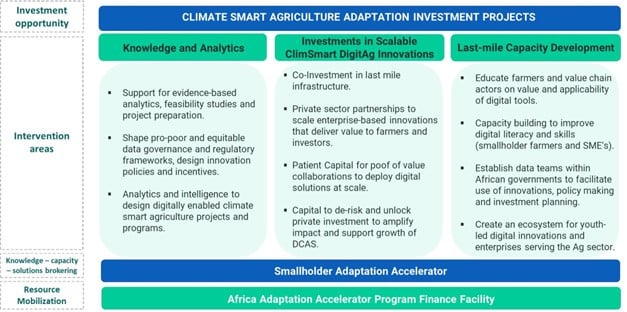
2025 Goal: Scale-up uptake of climate-smart digital technologies, and associated data-driven agricultural and financial services, for at least 30 million farmers in Africa by 2025, leading to increased food security for at least 10 million people in 26 Least Developed Countries (LDCs).
Expected Outcomes
- Malnutrition reduced for 10 million people;
- 40% yield and income increase for smallholders participating in the program;
- 50% increase in digital literacy of the actors in the agriculture sector participating in the program (80% women and youth);
- 30% de-risked credit as a result of the use of Digital Climate Advisory Services and Digital Finance Services; and
- 30% increase in the use of index insurance products by smallholders participating in the program.
PILLAR 2: AFRICA INFRASTRUCTURE RESILIENCE ACCELERATOR
Currently, Africa’s infrastructure needs are at about $130-170 billion a year, with an investment gap of over 50-60% of that amount. Making Africa’s infrastructure resilient adds only an average of 3% to total costs, but every dollar spent could yield four dollars of benefits. Investing in sustainable and resilient infrastructure systems can help achieve 72% of the SDGs. While infrastructure features prominently in the Nationally Determined Contributions (NDCs) and National Adaptation Plans (NAPs) of several African countries, they do not receive the level of resources that other sectors receive with respect to adaptation.
The Africa Infrastructure Resilience Accelerator Pillar will accelerate infrastructure resilience efforts on the continent - supporting the Paris Alignment, the Sendai Framework and the SDGs. It will strengthen the enabling environment in countries and provide the technical support to scale up investment in resilient infrastructure through public-private partnerships. It will also ensure that new and existing infrastructure incorporate nature-based solutions and create positive socioeconomic impacts and green jobs. The development of an enabling environment to manage and allocate available water resource is considered of key importance to optimize the impact of infrastructural investments.
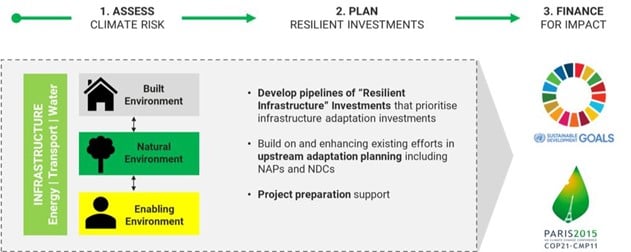
2025 Goal: Scale up investment at national and city level for climate-resilient infrastructure in key sectors such as water, transport, energy, and waste management, to at least $7 billion and integrate resilience in up to 50% (by value) of new infrastructure projects.
Expected Outcomes
- The enabling environments and capacities of 16 African countries and 32 African cities are strengthened and financial flows to resilient infrastructure investments are increased;
- Through project preparation and pre-investment support, mobilize financing and investments in adaptation and resilience in the water sector, in total achieving climate resilience designs in at least $7 billion worth of infrastructure investments; and
- Climate risks and resilience are considered for up to 50% (by value) in new infrastructure projects.
PILLAR 3: EMPOWERING YOUTH FOR ENTREPRENEURSHIP AND JOB CREATION IN CLIMATE ADAPTATION AND RESILIENCE
Africa’s burgeoning population, estimated at over 1,340 million in 2020, is the youngest in the world, with a median age of 19.7. Rapidly growing, Africa’s youth population is expected to double to over 830 million by 2050. Current estimates predict that as much as 50% of active youth in Africa may be unemployed, discouraged, or economically inactive by 2025.5 Youth provide an untapped potential to drive resilience through their innovativeness, energy, and entrepreneurship. The market and investment opportunities are significant, with African NDCs identifying market and investment opportunities estimated at about $3 trillion.
 The Empowering Youth for Entrepreneurship and Job Creation in Climate Adaptation and Resilience (Youth ADAPT) pillar aims to prepare a new generation of African youth for the transition towards green and climate resilient development, as well as to combat poverty and improve the quality of life for youth in Africa. It promotes sustainable job creation at scale through entrepreneurship and innovation for action on climate adaptation and resilience in Africa. It does this by combining business development, job creation and adaptation for youth. The flagship program aims at promoting innovation and inclusive growth for youth in partnership, developing skills and knowledge for employability on adaptation, building the entrepreneurial capacity of African youth, and facilitating access to funding and mentorship for youth-led green and climate resilient businesses in Africa with particular attention to young women-led businesses.
2025 Goal:Promote sustainable job creation for 1 million youth directly through education, entrepreneurship and inno-vation for action on climate adaptation and resilience in Africa , while enabling job creation for adaptation in 50% of African countries through policy reforms.
Expected Outcomes
- Legal, policy and regulatory reforms enacted to remove structural barriers that prevent youth participation in climate adaptation businesses and jobs;
- Youth Adaptation Solutions Challenge, a competition, award and incubator program with 300 youth-led MSMEs on adaptation supported;
- One million youth with enhanced skills for jobs in adaptation and climate resilience;
- Up to $3 billion unlocked in business opportunities for adaptation action by innovative youth-owned enterprises (50% women-led); and
- Adaptation jobs mainstreamed as key focus area in development projects and operations.
PILLAR 4: INNOVATIVE FINANCE INITIATIVES
Africa received only 4% of tracked global climate finance in 2017-18 – an average of $30 billion per year, with only just about $6 billion directed to adaptation and resilience initiatives. This falls far behind the $7-15 billion that was estimated annually as needed by 2020 per year, and the $50 billion by 2040.6 The African Development Bank estimate that adaptation and resilience costs for the continent will reach up to $30 billion per annum by 2030. If sustained action is not taken, the IMF estimates that this cost could be up to $50 billion per annum by 2040.7 GCA’s analysis has found that the funding for adaptation and resilience is going down due to the Covid-19 emergency.
Evidently, a step change is required to ensure sufficient resources to respond to the needs of the continent. Jointly, both organizations aim to support African countries adapt and become climate resilient through innovative finance instruments and mechanisms. The AAAP Innovative.
 Finance Initiatives (IFI) Flagship will achieve this objective by addressing key barriers through a series of initiatives across six crucial areas:
- Supply of adaptation finance: Greatly enhanced mobilization of adaptation finance from domestic and international public and private sources.
- Access: Step change in number and nature of actors channeling A&R finance, including through enhancing the ground-breaking direct access modality.
- Preparedness: Better understanding of level of exposure to climate risks and management through stronger technical, financial and institutional resilience against climate hazards.
- Bankable pipelines: New pipelines, demonstrating business case for transformative investment in A&R.
- Private finance and investment at scale: New instruments and mechanisms to aggregate interventions, mobilize investment, transfer risk, ensure compliance and track impact, and achieve private sector engagement at scale.
- Capacity: Long-lasting capacity built in key financial system stakeholders (including Central Banks, Min. Finance, NDBs) and the private sector (Banks, Pension Funds, SWF) mainstreaming high-quality resilience interventions into financial decision making on the continent.
2025 Goal: Coordinate with the other three Pillars and together increase financial flows for adaptation and resilience to Africa by $12.5 billion by 2025 to complement the $12.5 billion commitment of the African Development Bank.
Expected Outcomes
- Countries supported by the Technical Assistance Program to Access Climate Funds (TAP) to mobilize funds at scale for adaptation and resilience to Africa, linked to projects from the other AAAP pillars;
- New tools (green bonds that emphasize adaptation and resilience, adaptation benefit mechanism, and debt for resil-ience swaps) are developed and used;
- National finance ministries to increasingly allocate national budgets to adaptation; and
- Central banks and other financial institutions significantly increase their financial flows and investments to support adaptation in line with the Paris Agreement.